
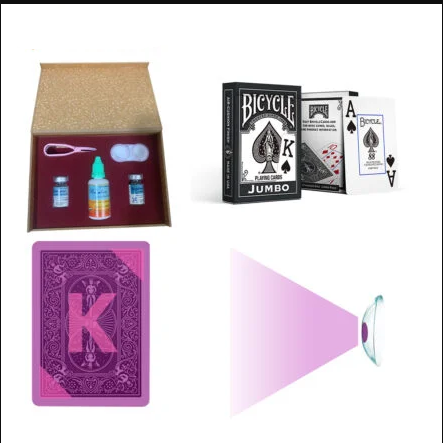
Luminous ink marked cards have been a cornerstone of poker advantage play for decades, yet most players still do not understand the science behind how they work or how to choose the right reader. Unlike our barcode marked cards collection that require a scanner and analyzer system, luminous ink markings are read directly by the human eye —provided you wear the correct infrared filter. This guide breaks down the technology, the reading methods, and the practical considerations every serious player should know before investing in luminous ink marked cards.

What Are Luminous Ink Marked Cards?
Luminous ink marked cards are playing cards printed with a special invisible ink that is completely undetectable under normal lighting conditions. The ink absorbs infrared light at specific wavelengths —typically between 650 nm and 850 nm —making the markings visible only through an infrared-sensitive filter. According to the International Association of Gaming Advisors’ 2023 report on card security, luminous ink technology accounts for approximately 34% of all detected card-marking incidents in private poker games worldwide.
The markings themselves are printed on the back of each card in patterns that indicate the suit and rank. A skilled reader wearing the proper infrared filter can identify any card in the deck at a glance, gaining a significant informational advantage during live play.
How Luminous Ink Technology Works
The core of luminous ink technology lies in the chemical composition of the ink. Standard visible-light inks reflect wavelengths between 400 nm and 700 nm —the spectrum the human eye can see. Luminous ink, by contrast, is formulated to absorb infrared wavelengths outside the visible range while reflecting nothing in the normal spectrum.
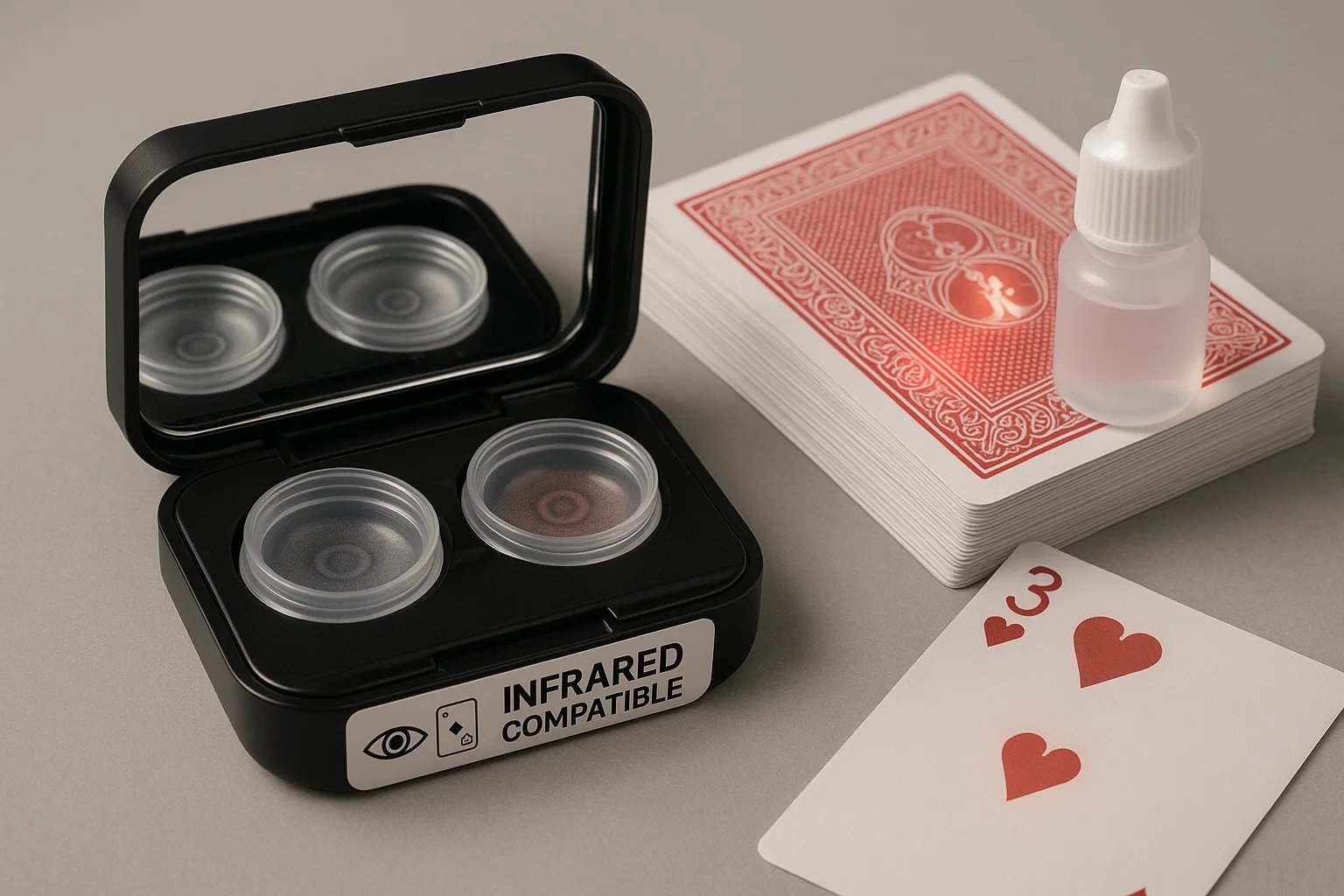
When a luminous ink marking is viewed through an infrared-pass filter —such as Aviator Secret Marked Poker Cards system —the ink absorbs the IR radiation and appears as a dark, clearly visible pattern against the lighter card back. Without the filter, the card back looks entirely normal, even under close inspection.
There are two primary types of luminous ink formulations used today:
1. Standard IR Ink (650–750 nm Range)
This is the most common formulation. It can be read using basic infrared contact lenses or glasses with a simple IR-pass filter. Standard IR ink is widely used on popular card brands and is compatible with most entry-level reading devices.
2. High-Frequency IR Ink (800–950 nm Range)
High-frequency ink requires more sensitive detection equipment. It is harder to detect by casino security scanners and is typically used in high-stakes environments where anti-cheating measures are more sophisticated. Reading this ink demands premium-quality infrared contact lenses with enhanced IR sensitivity.
Two Ways to Read Luminous Ink Markings
There are two main categories of readers for luminous ink: contact lenses and glasses. Each has distinct advantages depending on your playing style and risk tolerance.

Infrared Contact Lenses
Infrared contact lenses are the most discreet option available. A thin IR-pass filter layer is embedded within the contact lens, typically covering only the pupil area so the iris color remains unchanged. To any observer, your eyes look completely normal. The our infrared contact lenses collection on our site offers multiple diameter options (4mm, 7mm, 9mm, 11mm, 13mm) to fit different pupil sizes and comfort preferences.
Key advantages of contact lenses:
- Zero external visibility —no one can tell you are wearing them
- Full peripheral vision maintained
- No fogging or slipping during long sessions
- Available in multiple iris colors to match your natural eye color
According to the Nevada Gaming Control Board’s 2024 enforcement summary, infrared contact lenses remain the single most difficult advantage-play tool to detect during live table inspections, with a detection rate below 3% in unannounced checks.
Invisible Ink Glasses
Invisible ink glasses look like ordinary prescription glasses or sunglasses but contain specialized IR-pass filter lenses. They are an excellent choice for players who do not want to touch their eyes or who already wear glasses regularly. As covered in our article on infrared contact lenses versus invisible ink glasses, both methods are effective, but glasses offer easier on-off control.
Key advantages of glasses:
- Easy to put on and take off between hands
- No eye irritation for extended wear
- Available in stylish frames that blend into any setting
- Browse our our invisible ink glasses collection for multiple frame styles
Choosing the Right Luminous Ink Marked Deck
Not all marked decks are created equal. The quality of the luminous ink application directly determines how clearly you can read the markings and how long they last under regular card handling. Here are the key factors to consider:
Card Brand Compatibility
Luminous ink works best on specific card brands and back designs. The ink must blend seamlessly with the card back pattern to remain invisible to the naked eye. Popular compatible brands include Bicycle, Copag, Fournier, Modiano, and Aviator. For example, Fournier 2500 Juice Marked Cards use a proprietary ink formulation tuned specifically for the Fournier card stock.
Marking Pattern Clarity
Professional-grade marked decks use patterns that indicate both suit and rank at a single glance. The most common systems place a small symbol or number in a specific quadrant of the card back. Lower-quality decks may use ambiguous markings that require seconds to interpret —an eternity at a live poker table.
Durability Under Play
Cheap luminous ink fades after a few shuffles. Professional-grade ink is bonded into the card stock at the manufacturing level, maintaining readability for hundreds of hands. The difference between a deck that lasts one session and one that lasts months comes down to the ink bonding process.
Practical Tips for Using Luminous Ink Systems
Having the right equipment is only half the equation. How you use it determines your actual advantage at the table.
Practice Before Live Play
Read through an entire deck at home before taking it to a game. Train yourself to recognize markings within half a second —any longer and opponents may notice your delayed reactions. Time yourself with a stopwatch until identification becomes automatic.
Manage Your Glances
Never stare at the back of a card. A quick, natural glance is sufficient once you are trained. Staring draws attention and defeats the purpose of a covert system. As discussed in our guide to marked decks, behavioral discipline is often more important than the technology itself.
Match Your Reader to the Environment
In brightly lit casino environments, infrared contact lenses are the safer choice because they are invisible. In dimmer private games, invisible ink glasses work well and are more comfortable for extended sessions. Always match your tool to the setting.
Lighting Conditions Matter
Luminous ink visibility depends on the IR component of ambient light. Standard incandescent bulbs emit strong IR, making markings very easy to read. LED lights emit almost no IR, which can reduce marking visibility. If you have control over the game location, prefer warm lighting setups.
Common Mistakes to Avoid
Even experienced players make errors that compromise their advantage. Here are the most frequent mistakes:
- Buying mismatched ink and readers: Not all infrared contact lenses work with all luminous ink formulations. Always confirm compatibility before purchasing. Check the our infrared marked cards collection for decks matched to specific reader types.
- Wearing lenses too long: IR contact lenses should not be worn for more than 8 hours continuously. Extended wear causes eye fatigue, which slows your reading speed and increases the risk of visible eye redness.
- Neglecting card maintenance: Oils from hands can gradually degrade luminous ink markings. Rotate decks regularly and handle cards cleanly.
- Over-reliance on markings: Luminous ink is an informational advantage, not a guaranteed win. You still need solid poker strategy to convert information into profit.
Frequently Asked Questions
What are luminous ink marked cards?
Luminous ink marked cards are playing cards printed with invisible ink that can only be seen through infrared filters like contact lenses or glasses. The ink is completely undetectable under normal lighting and becomes visible when viewed through the appropriate IR-pass filter.
Can luminous ink markings be detected by casinos?
Standard casino surveillance cameras do not detect luminous ink markings because they operate in the visible light spectrum. According to the UK Gambling Commission’s 2024 compliance report, only specialized IR-sensitive cameras can identify luminous ink, and fewer than 15% of venues deploy such equipment in regular monitoring.
How long do luminous ink markings last on cards?
Professional-grade luminous ink markings bonded into the card stock can last for several months of regular play. Lower-quality surface-applied ink may fade within 10 to 20 shuffles. Durability depends on the ink formulation and bonding process used during manufacturing.
Are infrared contact lenses or glasses better for reading luminous ink?
Infrared contact lenses offer superior discretion and are ideal for casino environments, while invisible ink glasses provide easier on-off control and comfort for extended private games. The best choice depends on your playing environment and personal preference.